Family of Love
For this reason I bow my knees to the Father of our Lord Jesus Christ,
from whom the whole family in heaven and earth is named (Ephesians 3:14-15)
Becoming a Christian is not:
- becoming religious
- embracing a particular form of faith
- joining a denomination
- being a member of a church
- deciding to adhere to a set of rules
- or even trying to be good
But as many as received Him (Jesus), to them He gave the right to become children of God, to those who believe in His name (John 1:12)
At the heart of Christian belief lies a profound truth: God not merely loves but is, in His very essence, Love itself (1 John 4:8). This love, eternal and flowing over, does not remain confined within God’s own being but reaches outward, to beings created capable of receiving and reciprocating love. Creation, particularly mankind, was the result of God's desire to share His love with those made in His own image, those designed with the freedom to respond.
God is Love in Himself
Scripture affirms that God is love, not as an attribute or occasional action, but as the very core of His being (1 John 4:8). Within the Trinity, there exists an eternal, perfect relationship: the Father loves the Son (John 17:24), the Son loves the Father (John 14:31), and the Holy Spirit is described as the bond of love poured into human hearts (Romans 5:5).
Augustine, in De Trinitate, emphasized this inner-Trinitarian love, arguing that God's love did not begin at creation but has always existed within Himself. The Father, Son, and Spirit exist in a relationship of mutual giving and receiving, complete and lacking nothing. Thus, creation is not an act of filling a void but the natural overflow of divine generosity, extending love outward.
Mankind: Created for Relationship
When God created mankind, He declared, "Let us make man in our image, after our likeness" (Genesis 1:26-27). This deliberate act sets humans apart as relational beings, mirroring God's own relational nature. God created countless stars, a virtually infinite universe, an abundance of living creatures, but initially He created one man. Moreover, God formed Adam personally, breathing life into him (Genesis 2:7), highlighting the intimacy and care involved.
Irenaeus, in Against Heresies, described humanity not as a static creation but as a being designed to mature into the likeness of God. Man was meant to grow in relationship, gradually entering into deeper fellowship with the Creator. This process, however, required freedom. Love that is coerced is not love; it must be freely chosen. Thus, the capacity to choose was woven into the very fabric of human nature.
The Risk of Freedom and the Reality of Sin
Freedom carried risk. In Eden, Adam and Eve were given the choice to trust God's goodness or turn away (Genesis 2:16-17). Their choice to rebel introduced sin and separation, yet it did not thwart God's loving purpose. Instead, Scripture reveals God's persistent desire to restore relationship: "When Israel was a child, I loved him" (Hosea 11:1), and "Can a woman forget her nursing child? Even these may forget, yet I will not forget you" (Isaiah 49:15).
Throughout history, God pursued His people, inviting them back into covenant, offering forgiveness, and pointing forward to ultimate restoration.
"I will be a Father to you, And you shall be My sons and daughters, Says the Lord Almighty.” (2 Cor 6:18)
Redemption: A Predetermined Act of Love
In the fullness of time, God sent His Son, the embodiment of divine love (John 3:16, Romans 5:8), to reconcile humanity. Christ's mission was not merely transactional but relational: to draw humanity back into the family of God.
But as many as received Him, to them He gave the right to become children of God, to those who believe in His name (John 1:12)
Paul writes, "You have received the Spirit of adoption as sons, by whom we cry, 'Abba! Father!'" (Romans 8:15-17). Through Christ, believers are not only forgiven but adopted, embraced as sons and daughters, restored to the intimate relationship God intended from the beginning.
Behold what manner of love the Father has bestowed on us, that we should be called children of God! (1 John 3:1)
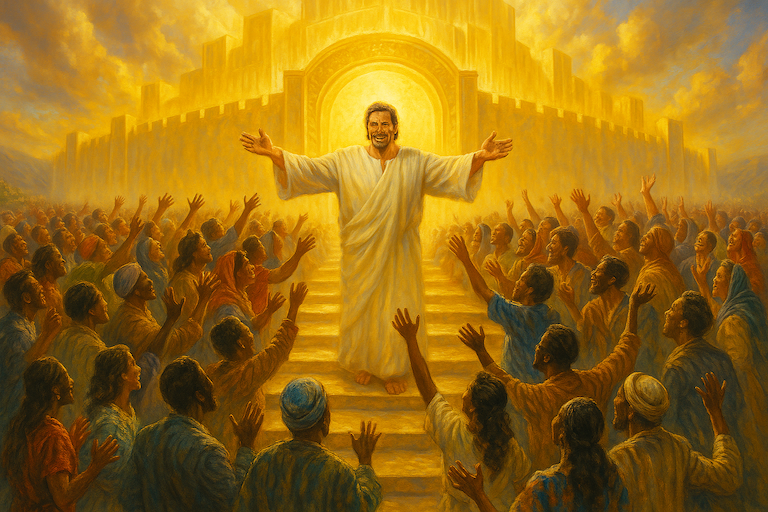
The Final Vision: Perfected Communion
The Bible closes with a vision of consummated love:
"Behold, the dwelling place of God is with man. He will dwell with them, and they will be His people, and God Himself will be with them" (Revelation 21:3-4).
Here, God's plan reaches its fulfillment: a perfected family, gathered in love, dwelling eternally with their Creator.