Fall of Lucifer, The Anointed Cherub
A Six-Day Rebellion Within the Framework of Creation
“In the beginning, God created the heavens and the earth.” (Genesis 1:1)
The fall of Lucifer—his rebellion and expulsion from God’s presence—is often assumed to have taken place in a distant prehistory, long before the creation of the world. There is both theological and scriptural insight that supports an alternative understanding: that Lucifer’s fall occurred during the six-day creation period, sparked by the unveiling of God’s purpose in Man.
This article presents a coherent narrative of Lucifer’s fall in light of creation week, shows how temptation matures into sin (James 1:14–15), and offers responses to common theological objections.
Lucifer: A Created Being Among the ‘Heavens’
Genesis 1:1 declares that God created “the heavens and the earth.” The heavens were created before the earth. The phrase, “heavens” likely encompasses both the visible cosmos and the invisible spiritual realm. Colossians 1:16 affirms that all spiritual beings—“thrones or dominions or rulers or authorities”—were created by God through Christ.
Among these beings was Lucifer, described in Ezekiel 28:12–15 as full of wisdom, beauty, and perfection. He was created blameless and assigned high status, perhaps even worship leadership. His title as “morning star” (Isaiah 14:12) suggests prominence among the heavenly host.
At this point, iniquity had not yet been found in him. He stood among those who rejoiced at the founding of the earth (Job 38:7).
Man: The Image of God and the Catalyst of Pride
On the sixth day of creation, God made Man in His own image and likeness (Genesis 1:26–28), a unique act of divine self-expression and a status never ascribed to angels. Man, though formed from dust, was entrusted with dominion over the earth and appointed as God’s representative ruler.
This singular act of divine favour might well have been the provocation that led to Lucifer’s rebellion. Though created noble, iniquity was found in him (Ezekiel 28:15) as he beheld a being, apparently inferior to himself, placed above him in God’s plan. Envy and pride arose: “I will ascend…I will be like the Most High” (Isaiah 14:13–14). The idea of a lower being, made of clay, receiving such honour was intolerable to one so exalted.
His fall was not necessarily gradual but reactive and swift, prompted by the sudden unveiling of humanity’s exalted destiny. This affront to Lucifer quickly infected a third of the angelic host, who were likewise offended (Revelation 12:4). This heavenly defection unfolded within the time frame of creation week—not across aeons, but in tandem with God’s forming of the world.
Thus began the progression from temptation to rebellion. As Ezekiel 28:17 states: “Your heart was proud because of your beauty; you corrupted your wisdom for the sake of your splendour.”
Here we may observe the beginning of temptation: the seed of rebellion that formed in response to God’s exaltation of man.
The Process of Iniquity: From Temptation to Death
James 1:14–15 offers vital insight into the inner mechanics of sin:
“But each person is tempted when he is lured and enticed by his own desire. Then desire when it has conceived gives birth to sin, and sin when it is fully grown brings forth death.”
This spiritual sequence can be applied to Lucifer:
- He was tempted by envy and pride.
- He became enticed, nourishing a desire to rise above his appointed station.
- Over time, this desire conceived sin, culminating in active rebellion.
- The result was spiritual death—eternal separation from God.
The Fall Manifested: The Garden of Eden
Lucifer’s iniquity was consummated in the Garden of Eden, where he actively worked to corrupt mankind who bore the image of God. There, under the guise of the serpent, he tempted Eve to eat the forbidden fruit (Genesis 3:1–6). His deception of Eve was not only a blow against man, but an expression of his rebellion against the divine order itself.
It was in this act that sin reached full term. His desire, having conceived, gave birth to malice and treachery. Lucifer’s spiritual death—the full severance from God's holiness—can be seen as taking place in this act. He became Satan, the adversary, and the father of lies (John 8:44).
Time Considerations: How Long After Creation Did the Fall Occur?
Scripture does not specify how soon after creation the fall of man occurred, but several clues suggest it was not long:
Adam and Eve had not yet conceived children before the fall (Genesis 4:1), which suggests a relatively brief span. Though the text of Genesis only requires that Cain and Abel be born before Seth when Adam had lived 130 years.
Genesis 3 follows Genesis 2 with narrative immediacy, without any indication of years passing.
God’s Sabbath rest (Genesis 2:2–3) is broken only with the introduction of sin. The integrity of that rest may imply a swift disruption—possibly just after the seventh day.
Thus, while Lucifer’s temptation and internal rebellion may have begun during creation week, the full expression of sin—the fall—occurred soon after.
Eden Was Earthly, Not Merely Spiritual
Ezekiel 28:13 says, “You were in Eden, the garden of God.” While some interpret this Eden as a heavenly archetype, Genesis presents Eden as a real place on Earth, described with geographic markers and rivers that can be identified even today (Genesis 2:10–14).
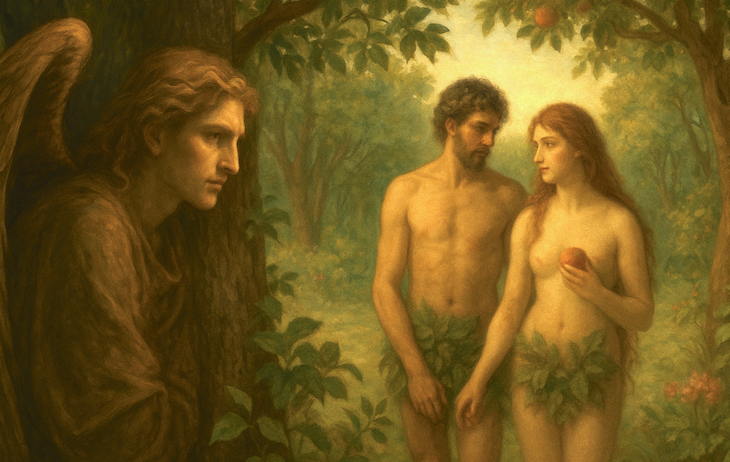
There is no reason to assume Eden was spiritual. Lucifer could have had access to the garden of God before his fall, perhaps even in a role of oversight or observation. It was there that his iniquity came to fruition, not in some remote celestial rebellion.
God’s Eternal Plan: The Lamb Slain from the Foundation
Though Lucifer's rebellion and man’s fall introduced sin into the created order, God was not surprised. As Revelation 13:8 declares, Christ is “the Lamb slain from the foundation of the world.” The redemptive work of Christ was not reactive, but eternally foreordained (1 Peter 1:20).
Isaiah 46:10 reminds us that God “declares the end from the beginning.” The fall was permitted within the sovereign plan of redemption. In that sense, the cross and resurrection were not an afterthought— they were the central purpose around which creation was designed. Christ’s redemptive work was embedded in the eternal counsel of God before time began. Even as Lucifer fell, the cross was foreseen; the triumph of love was never in doubt.
Conclusion
Lucifer’s fall began with pride and envy, triggered by the unveiling of God’s purpose for man. It unfolded within creation week, maturing shortly thereafter in Eden. His rebellion was not the result of aeons of slow corruption, but a rapid and decisive rejection of divine order—culminating in the temptation of Adam and Eve.
Understanding Lucifer’s fall in this way magnifies the drama of creation, the dignity of humanity, and the majesty of a God who wrote redemption into the very fabric of the cosmos—before the first star was lit.