The Wise Men and the Star
The story of three wise men humbly bringing their gifts to the newborn king, the shepherds sent by the angels, the cattle lowing in the manger and the star glistening above the stable are all images integrated with the nativity of Jesus. How much of this is artistic convenience, how much tradition and how much fantasy? The Scripture is our only inerrant source. What can we glean from that which the Holy Spirit has chosen to reveal to us in the Gospels? From the second chapter of Matthew:
2:1 Now after Jesus was born in Bethlehem of Judea in the days of Herod the king...
Note the timing, after the birth of Jesus, not at the same time. The shepherds would not still be hanging around the stable, they had a responsibility for the sheep, “Then the shepherds returned, glorifying and praising God…” (Luke 2:20). ‘After’ could mean any indeterminate time period subsequent to the stable event, but it does not mean ‘at the same time’.
Convenient as it is for a Christmas dramatization, the wise men cannot be in the same scene as the shepherds.
2:1 ...behold, wise men from the East came to Jerusalem
These were wise men, not Babylonian astrologers. It is not improbable that they were from Babylon, which was a cultural centre in the East, but they were most certainly not astrologers.
They might possibly have been descendants of the Jews from the time of the Babylonian captivity. They were wise in that they were well acquainted with the normal appearance of the night sky, and of the normal arrangement of the stars, and they had noticed a something different.
They came to Jerusalem. Why Jerusalem? If they were following a moving star in the sky, why would the star lead them to Jerusalem? The conclusion is that they were not following a star. They had seen the star in the East and had surmised that Jerusalem was the place they should be.
2:2 ...saying, “Where is He who has been born King of the Jews? For we have seen His star in the East and have come to worship Him.”
This substantiates the probability of the wise men being Jews. They came to worship the King of the Jews. They saw His Star in the East. Something about the star caused them to acknowledge that it was 'His Star'. From their vantage point in the east, they were looking eastward to see the star. Subsequently they travelled west to Jerusalem, illogical if they were employing astronomical wisdom.
The expectancy of a coming King of the Jews would be well establised in their literature. In their wisdom, and true wisdom comes from God, they had concluded that they must travel to Israel. Such a journey, of two or three months, would constitute a considerable investment in time, energy and resources. They were not out on a whim, they were confident in their cause, convinced that something extraordinary was happening.
They saw his star, singular. A single star, not a conjunction of 2 or more bodies, as some commentators state. These magi were wise enough to know the difference between a star and a conjunction of planets.
They arrived in Jerusalem, the capital, and began to ask around ‘Where is he who has been born King of the Jews’, assuming that this event would be common knowledge among the people. They didn’t enquire directly from the authorities.
2:3 When Herod the king heard this, he was troubled, and all Jerusalem with him.
Their enquiries caused quite a stir in Jerusalem and had reached the ears of Herod’s court. Anxiety gripped those who thought they had control of power. Their authority over the people was under severe threat.
2:4 And when he had gathered all the chief priests and scribes of the people together, he inquired of them where the Christ was to be born.
:5 So they said to him, “In Bethlehem of Judea, for thus it is written by the prophet:
:6
‘But you, Bethlehem, in the land of Judah,
Are not the least among the rulers of Judah;
For out of you shall come a Ruler
Who will shepherd My people Israel.’ ”
:7 Then Herod, when he had secretly called the wise men, determined from them what time the star appeared.
After the wise men enquired round about in Jerusalem, they were summoned to a private audience with King Herod. Herod, having conferred with ‘all the chief priests and scribes of the people’ asked about the time when the star had ‘appeared’. Under normal circumstances, stars don’t just appear, unless it’s the appearance from below the horizon, in which case every star, planet and moon appears daily, and there is nothing spectacular about this particular star that warrants them making such an arduous trek?
Herod asked for a specific (exact) time when the star appeared. This star had apparently suddenly, unexpectedly and spontaneously appeared where there was no star before. Moreover, it seems that it had disappeared again, which is why the wise men came enquiring in Jerusalem. They had seen his star in the East, and apparently it was no longer to be seen.
2:8 And he sent them to Bethlehem and said, “Go and search carefully for the young Child, and when you have found Him, bring back word to me, that I may come and worship Him also.”
The wise men had declared their intent to worship the KIng of the Jews. Herod feigns this same intent in order to enlist the help of the wise men.
Note that the expression ‘young child’ is used and not the ‘babe’ wrapped in swaddling clothes, lying in a manger (Luke 2:12). The words in the original Greek for ‘young child’ and for ‘babe’ are explicitly different.
Herod sent them to Bethlehem, according to the information given him by the scribes.
2:9 When they heard the king, they departed;
At this point the wise men had doubtless seen through Herod’s connivings, and determined not to cooperate with him.
2:9 and behold, the star which they had seen in the East went before them,
After they had left the king, behold the star appeared again. They obviously recognised it and trusted it enough to defy Herod’s command. The star appeared and this time it was moving. Reminiscent of the cloud by day and the pillar of fire by night which had led the Israelites through the wilderness, this ‘star’ seemed to be leading them.
2:9 till it came and stood over where the young Child was.
What a star is this! It appears, disappears, appears again, moves and stops still. It unmistakably identifies a very specific place, the house where the young child was.
2:10 When they saw the star, they rejoiced with exceedingly great joy.
This exuberance would have been out of place had the star been leading them all the way from the East to Jerusalem to Herod’s palace. They rejoiced ‘with exceeding great joy’ because they hadn’t seen the star since they had left the East, and now they welcomed it like a beloved friend.
2:11 And when they had come into the house,
The star had now led them, with pinpoint accuracy, to a house, not a manger, a specific house. No star or conjunction in outer space can point specifically to a tiny house.
2:11 they saw the young Child with Mary His mother, and fell down and worshiped Him.
They knew immediately and instinctively that this was ‘He who has been born King of the Jews’ . Their journey had been a resounding success. They will now fulfill what they set out to do, they fell down and worshiped him.
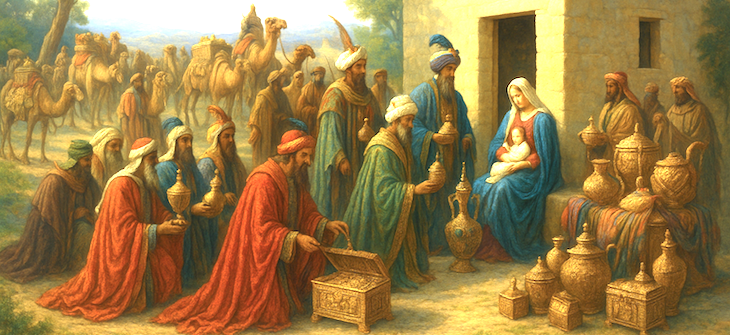
2:11 And when they had opened their treasures, they presented gifts to Him: gold, frankincense, and myrrh.
Here are mentioned 3 types of gifts. Does that mean there were only three wise men? There may have been just two. Were the wise men Jews, spiritual descendants of Daniel and his colleagues? If so, there may have been 12 of them, representing each of the 12 tribes, with a large caravan; they would have brought camel loads of gold, frankincense and myrrh, and very likely many other things. They ‘opened their treasures’, they didn’t just pull out from their pocket a little box.
Their identities, their efforts, their persistence and the use of the word 'treasures' all imply that these gifts were probably very substantial.
2:12 Then, being divinely warned in a dream that they should not return to Herod, they departed for their own country another way.
The whole event has been divinely choreographed; from the appearance of the ‘star’ in the east to negotiating the danger from the jealous ruling authorities to finding the exact place where the child was and now to their safe return to their own country.
When did they visit the house?
After 40 days purification and the presentation in the temple, Joseph took his family back to Nazareth (Luke 2:39). If the magi had spoken to Herod and had visited Jesus before the 40 days had expired it would be a very risky and dangerous affair to present Jesus at the temple, considering Herod’s rage.
They visited Jesus when he was a young child, at a house, at least a couple of months after Jesus birth, and probably a couple of years considering Herod’s murderous reaction (Matt 2:16).
Where was this house then?
Was the house in Jerusalem, Bethlehem, maybe where Mary’s cousin Elizabeth lived? No, they had already left the Jerusalem area and departed for Nazareth. Most likely the house was Joseph’s own dwelling in Nazareth.
2:13 Now when they had departed, behold, an angel of the Lord appeared to Joseph in a dream, saying, “Arise, take the young Child and His mother, flee to Egypt, and stay there until I bring you word; for Herod will seek the young Child to destroy Him.”
2:14 When he arose, he took the young Child and His mother by night and departed for Egypt
When the wise men had departed Joseph fled with his family to Egypt, apparently the very next morning after the wise men left. By this time they were probably very rich from the Magi’s gifts and could afford speed and luxury in travel, staying ahead of Herod.
In conclusion
Angels and dreams figure prominently throughout the nativity story. It is highly likely that the wise men’s star was an angel that had appeared to them in the East, in the guise of a star, with specific intructions to go 'worship him who is born to be king of the Jews' (which according to natural thinking would be in Jerusalem). At Jerusalem the angel appeared again to guide them directly to the house where the child Jesus lived.
The episode with Herod and Bethlehem was an unsuccessful red herring attempt by the devil to spoil God’s plan.